

There are competing partisan narratives about the size of government relative to the economy in advanced Western economies. On the left, the neoliberalism of the 1980s and 1990s destroyed the ability of governments to take care of those most in need, and by taxing the rich we can address many social ills. On the right, the Reagan and Thatcher years may have fixed some issues like inflation, but the actual size of government was never cut, and with each year, it slowly gets worse.
Neither narrative is really correct.
I have no interest in talking about the partisan politics of the issue.
If you look at all the major advanced economies, the problem is Social Security and pensions. There are no medium or long run trends in government consumption, government investment, or government ownership of the economy. The area where there are systematic increases is in transfer payments, and that is driven largely by aging populations.
Serious commentators across the political spectrum understand this is a problem. It is also politically radioactive. A great irony is that people in public policy see the problem of a growing state and understand its nature, while many of those demanding action against the growing size of government would prefer no action be taken on the dimension of public policy that is actually the problem.

We discussed previously that the size of government can be boiled down to two-ish concepts that are negatively correlated with one another. The first is government consumption, transfers and subsidies, and the top marginal tax rate. Call that “the welfare state.” The second is government investment and government ownership over the economy. Call that “socialism.” State capacity is positively correlated with the welfare state and negatively correlated with socialism. Yes, let me repeat: across countries, the welfare state is negatively correlated with socialism.
There are two ways of having a small size of government. The first is that the country is too poor to have a large size of government. That is the normal way. The second way is something no one really understands. The second possibly relates to Spanish colonialism.
There are three ways of having a large size of government. The first is that a country is wealthy and can afford to. This is called “Wagner’s Law.” That is the most normal way. The second most common way is the natural resource curse, where all sorts of money (often but not always from oil) flows into the coffers of the state without the state needing to do anything to get it. The third consists of governments that did not observe that socialism’s use-by date was 35 years ago, and they’re still trying to make it work.
There is a lot of overlap between categories two and three. There is almost no overlap between the Wagner’s Law countries and the other two groups, except Norway. Maybe Canada. Norway is in constant existential crisis because of all the money they get from oil while being ideologically opposed to fossil fuels. Canada’s oil money comes from the province of Alberta, which is presently considering secession.
If you look at the Size of Government rankings in Economic Freedom of the World, what you will see is an incoherent mess. Several wealthy countries have among the lowest index scores (largest governments), but they’ll be standing next to, um, Algeria. At the top of the list are many impoverished countries, but then there is a stray Hong Kong here and there.
An exercise I did a few years ago was to say, what if we controlled for Wagner’s Law? Well let me more formally introduce it as a concept. The regularity, which was first observed back in the 19th century, is that as a country’s GDP grows, almost inevitably the public sector share of GDP grows. We can argue about why. But it happens.
There are three pieces of the Size of Government I identify as the welfare state. What if I take each of these pieces, and see how much of each I can explain using Wagner’s Law, that is, GDP per capita.[1] I can then take the part that is unexplained by Wagner’s Law for each of the variables, turn them back into index values on the same scale as the other Size of Government variables, and recalculate the Size of Government, now stripped of Wagner’s Law.
It was straightforward to do this with government consumption and transfers and subsidies. There was also a relationship with the top marginal tax rate, but it was too negligible to bother with (probably because having a very high top marginal tax rate suppresses your GDP).
When you make that adjustment, the rankings for the Size of Government suddenly look far more coherent. Here are the top 15 and bottom 10 countries, first unadjusted and then adjusted:
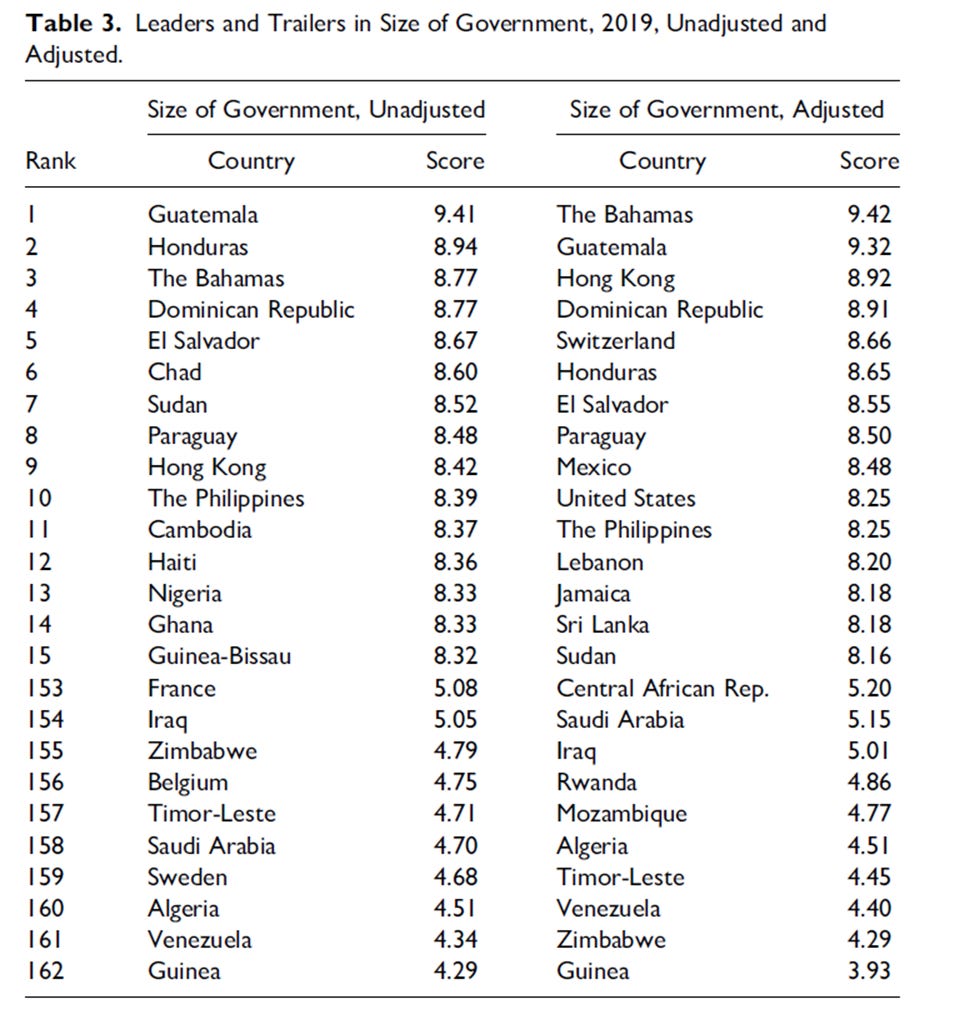
Some of the most impoverished countries in the world are near the top of the Size of Government score before the adjustment. But once they are adjusted downward, the pattern that emerges is quite clear: the countries with the smallest states in the world are in Latin America. That, in conjunction with the Philippines ranking eleventh (and maybe even the presence of the United States) makes Spanish colonialism a prime candidate for why states stay small.
Hong Kong, Switzerland, and the United States are all in the top ten. We can interpret this as evidence that a true commitment to free markets genuinely prevents governments from becoming large. We can interpret this as federalism and decentralized politics serving as a check on big government. Or we can interpret this as nothing because the sample size is three.
I believe the second column better reflects what the institution of a limited size of government looks like. I would not recommend putting this into Economic Freedom of the World. I mechanically stripped out the parts of the data that are positively related to GDP, which would make the index dishonest for the purposes of what we want it to be. I did check how it would affect the overall economic freedom rankings, and it affected them less than you would think, but that just means it would be pointless.
I also tried to look at some of the obvious relationships between the adjusted data and possible underlying causes, but didn’t get very far. It was also clear that simply controlling for GDP per capita in the statistical analysis itself accomplished the same thing as adjusting the Size of Government for Wagner’s Law, so the technique I developed is unnecessary for further formal statistical analysis.
Well what did we learn then? Governments stay small either because the country is poor or for mysterious reasons possibly related to Spanish colonialism. Governments get really big either because the country is rich enough to afford it, because of the presence of natural resources, or because they are live action roleplaying communism.

For a country like the United States to actually cut the size of government in some meaningful way that would show up in the index (rather than just stop its trajectory) is incredibly difficult. In some preliminary research, I looked at the biggest spending-side fiscal consolidations (when someone looked at the budget, said “oh no,” and actually got politicians on board with cutting stuff) in modern history and found essentially no effect on future index scores. Part of that is because of how Economic Freedom of the World and its Size of Government area are constructed. But part of it is also because people don’t have the stomach for it.
If something is both popular with experts and the public, we would already have done it. Proactively cutting Social Security benefits (rather than the automatic haircut that may happen in a few years) is incredibly unpopular, even though it would almost certainly reduce pain down the road. An attempt at enacting the popular idea of “reducing waste” just happened and it didn’t seem to amount to much in a positive direction.
I mean, what do you want to do? Close down public elementary schools? The world is a difficult place to make better.
Further Reading:
Ryan H. Murphy. 2022. “Breaking Wagner’s Law: Which Countries Have the Most Limited Government?” Public Finance Review 50, no. 4: 484-509.
Ryan H. Murphy. 2022. “Sizing Up the Size of Government.” In Bridwell Institute Annual Report 2021/2022, p. 2-8.
Ryan H. Murphy. 2024. “Accounting for Large Fiscal Government Size.” Economic Affairs 44, no. 3: 589-600.
[1] Actually, the natural log of GDP per capita.
I would like to see the scatterplot Wagner-adjusted government size over state capacity. What do you think is the reason Spanish colonialism led to weak state capacity down the line? Elite-heavy sovieties with the ability to push back on property and other broad taxes? Leading to a negative circle where the state offers little, thus there is low willingness to accept new taxes, thus the state continues to offer little, etc. Or large, untaxable informal economies? Or maybe the state capacity in the European societies come from constantly having to collect money for wars?
Great post, subscribed.